|
|
|
|
Bottom Line Up Front China's Ministry of Justice invoked its new anti-extraterritoriality regulation on May 15 against the European Commission's Foreign Subsidies Regulation probe of Nuctech, citing Articles 3 and 6 to bar any Chinese organization or individual from cooperating with the EU measures, in a joint action with MOFCOM that builds on a January 2025 trade barrier finding. Shanghai's cyberspace administration launched a four-month two-phase "Clear and Bright" enforcement campaign on May 16 covering 17 priority platforms across AI services, content, e-commerce, app stores and open source communities, targeting LLM registration gaps, training data safety, content labeling compliance, impersonation and water-army accounts, with Xiaohongshu, MiniMax and Pinduoduo already publishing governance notices. Caixin framed the May 14 Xi-Trump Beijing summit as defining a constructive and strategically stable U.S.-China relationship in a flagship analytical piece released to Data Pass subscribers on May 16, following Trump's May 15 departure from Beijing and distinct from Caixin's earlier Xinhua-sourced readout. |
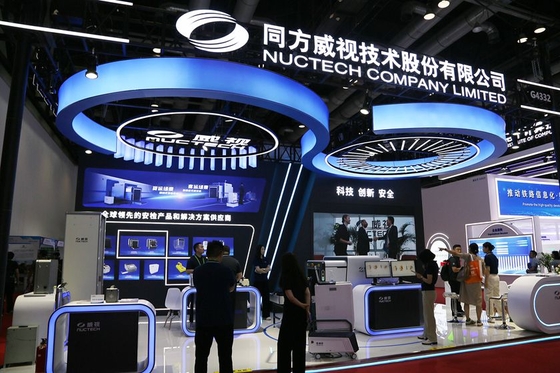 |
| MoJ invokes new anti-extraterritoriality regulation against EU Nuctech probe, barring any Chinese entity from cooperating The Ministry of Justice announced on May 15 that the European Commission's cross-border investigation practices against Nuctech (Tongfang Weishi) under the EU Foreign Subsidies Regulation constitute improper extraterritorial jurisdiction measures, Caixin reported. The determination invokes Articles 3 and 6 of the Regulations on Countering Improper Extraterritorial Jurisdiction, promulgated about one month earlier, and bars any organization or individual from executing or assisting the EU measures, effective the day of the announcement. MoJ said it acted jointly with MOFCOM after investigation, with the action building on MOFCOM's January 2025 finding that EU FSR practices constitute trade and investment barriers. |
| Shanghai opens four-month "Clear and Bright" enforcement campaign against AI application abuses across 17 named platforms Shanghai's cyberspace administration announced on May 16 a four-month two-phase campaign under the central CAC's unified directive, targeting AI service compliance and AI generated content abuses. Phase one focuses on noncompliance with mandatory LLM registration, weak security review capability, training data safety, AI data poisoning, and inadequate AI generated content labeling; phase two targets AI generated fake content, impersonation, harm to minors, and water-army accounts, with penalties for platforms, MCN agencies and websites. Shanghai CAC convened a May 13 deployment meeting with 17 priority platforms across five categories (AI platforms, content platforms, e-commerce, app stores and open source communities), and Xiaohongshu, MiniMax and Pinduoduo have already issued their own platform governance notices. |
| Caixin frames Beijing summit as defining a "constructive and strategically stable" U.S.-China relationship Caixin's weekly preview positions the May 14 Xi-Trump talks as establishing a "constructive and strategically stable China-U.S. relationship," released early to Data Pass subscribers ahead of magazine publication. The piece is the outlet's flagship analytical write-up of the summit and follows President Trump's May 15 afternoon departure from Beijing by chartered plane. The framing is distinct from the Xinhua-sourced summit readout the outlet separately carried. |
| Ant Group's Bailing team open-sources Ring-2.6-1T, a trillion-parameter reasoning model with adjustable inference intensity Ant Group's Bailing large language model team released Ring-2.6-1T, a trillion-parameter flagship reasoning model, with an adjustable Reasoning Effort mechanism supporting two inferenceInferenceRunning a trained AI model to answer a query, as distinct from training it. Inference is where most ongoing compute and energy demand now sits, and it is what chip export rules increasingly target alongside training. intensities. The "high" mode targets agent workflows requiring lower token overhead and faster multi-step execution, while the "xhigh" mode targets mathematics, scientific research and complex logical analysis requiring deeper reasoning. The weights are available on Hugging Face under the inclusionAI/Ring-2.6-1T repository and on ModelScope. |
|
| Tencent internally tests Marvis, an OS-level personal AI agent running on Hunyuan, DeepSeek V4 and Qwen Tencent has begun internal testing of Marvis, an OS-level multi-agent personal AI assistant that handles app, EXE, file management, document generation and computer operations. Marvis offers two run modes: a cloud "efficiency" mode using the latest Hunyuan and DeepSeek V4 models, and a local "privacy" mode using a Qwen end-side model that keeps all interactions on device. The product currently runs on Windows PC and Android with iOS and macOS support pending, and the name is a portmanteau of Pony "Ma" Huateng and "Jarvis." |
| Alibaba Health launches "Hydrogen Ion" medical AI built around an exclusive BMJ Group evidence partnership Alibaba Health launched "Hydrogen Ion," a medical AI assistant pitched at China's 5 million doctors, in Hangzhou on May 16. The launch drew leaders from Peking University, Tsinghua, Zhejiang and Shanghai medical institutions alongside a BMJ Group editor, with the product positioned around an exclusive BMJ Group evidence source partnership. Alibaba Health CTO Wang Xiangzhi cited general LLM medication advice errors, including a wrong missed-dose instruction for fluzerecept, as the motivation for the vertical product. |
| Shanghai Telecom retails LLM tokens through the phone bill, the first Shanghai carrier to do so China Telecom Shanghai launched a token-based computeComputeThe processing power used to train and run AI models, usually measured in chips, GPU-hours or FLOPs. service on May 16 at 1 yuan per 250,000 credit points with phone bill payment supported, becoming the first Shanghai carrier to retail LLM tokens through telecom billing, Yicai reported citing Shanghai Observer. Using the Kimi K2.5 model, 1 yuan covers approximately 250,000 input tokens, and credit-point holders can call more than 30 mainstream Chinese LLMs through standard API interfaces. A 10-yuan tier corresponds to 2.5 million credit points, enough to auto-summarize about 100 e-books of 100,000 characters each. |
|
| III | ROBOTICS & AUTONOMOUS SYSTEMS | |
| Huxiu maps a four-layer "robot data pyramid" and describes Chinese embodied AI as stuck in a data desert A Huxiu feature frames Chinese embodied AI as constrained by a "data desert" relative to the trillion-token corpora that power LLMs, and proposes a four-layer robot data pyramid as the analytical framework. The piece is based on on-site reporting at Shanghai robot data collection factories, with the team participating in teleoperation data collection firsthand. The reporting includes interviews with Zhiyuan (Agibot) and Sharpa on current robot data collection approaches. |
| TMTPost pegs embodied AI starting monthly salary at 62,000 yuan as Chinese universities open first undergraduate programs A TMTPost sector salary survey places starting monthly salary in China's embodied intelligence sector at 62,000 yuan, with unicorns reporting acute demand for "Chief Scientist" hires. Chinese universities have launched the first wave of undergraduate degree programs in embodied intelligence. The specific universities and the unicorns recruiting at the chief scientist level were not named. |
|
| Guangdong Unicom and Huawei deploy Greater Bay Area's first mobile AI radio access network across 1,000-plus sites Guangdong Unicom completed the Greater Bay Area's first Mobile AI high-quality experience network with Huawei, deploying wireless intelligent boards across Guangzhou, Shenzhen and Foshan. The deployment covers core venues including Shenzhen Universiade Center Stadium and Foshan Century Lotus Stadium, with over 1,000 sites upgraded under the "trusted data space" architecture. The carrier said token interaction latency for AI applications drops by more than 50% on supported devices, with WeChat file send speeds up over 30%. |
| CATL's "two major moves" mark a battery-to-compute pivot toward energy internet infrastructure CATL has spent tens of billions of yuan on two recent strategic moves repositioning the company from "battery supplier" to "energy internet infrastructure provider," per Jiemian. The framing aligns CATL's pivot with the State Council-named 15th Five-Year Plan compute network priority. The specific dollar amount per move and the specific compute infrastructure assets involved were not named. |
| CAS Space's Lijian-1 becomes first Chinese commercial rocket family to cross 100 satellites in orbit CAS Space's Lijian-1 Y13 carrier rocket "China Youxi" mission launched on May 15 from the Dongfeng Commercial Aerospace Innovation Test Zone, delivering the "Youxi" satellite and four others in a one-rocket-five-satellites configuration, Jiemian reported. The launch makes the Lijian series the first Chinese commercial rocket family to cross 100 cumulative satellites in orbit. CAS Space is a commercial spin-off from the Chinese Academy of Sciences. |
|
| MOFCOM frames MoJ Nuctech action as interagency escalation, demands EU halt FSR enforcement MOFCOM's spokesperson said in a same-day Q&A that the EU has escalated investigations against Chinese firms including Nuctech to "in-depth" investigations, forced Chinese banking institutions to cooperate, and unreasonably demanded extensive information within China unrelated to the investigations, Yicai reported. MOFCOM said its January 2025 determination already classified EU FSR practices as trade and investment barriers and that the EU has persisted on the wrong path. The spokesperson reiterated demands that the European Commission promptly correct its practices and stop the suppression of Chinese enterprises. |
| Caixin reads Cook-Huang front-row appearance at Great Hall as signal of post-summit commercial track Caixin's weekly preview notes Apple CEO Tim Cook and NVIDIA founder Jensen Huang were front-row attendees at the Great Hall of the People on May 14, framing the U.S. business delegation roster as reflecting the "profound evolution" of bilateral commercial interests. The piece is positioned as the outlet's analytical read on which U.S. tech firms Beijing is treating as strategic interlocutors, separate from the strategic stability framing piece released the same morning. It was pre-released for Data Pass subscribers ahead of the magazine's main publication. |
Huxiu carries U.S. AI practitioners' visit notes framing PRC labs as replaying the Toyota-Detroit playbook Huxiu published a Chinese-language write-up on May 15 of a group of U.S. AI practitioners' week-long visit to 14 Beijing, Hangzhou and Shanghai AI and robotics labs, with the framing that China's AI sector may be replaying Toyota's overtaking of Detroit. Companies visited include DeepSeek, Moonshot AI, MiniMax, Zhipu AI, ByteDance, 01.AI, Alibaba, Ant Group, Xiaomi, AInnovation, Galbot, Unitree, ModelScope and RWKV. China's deployable compute scale is roughly one-eighth of U.S. capacity but model capability lags only six to eight months, with Chinese labs extracting four to seven times more intelligence per unit of compute than the original scaling law predicted. |
|
|
|